
How to Run a Pinterest Giveaway (step-by-step)
Running a Pinterest giveaway comes down to seven moves: set a clear goal, choose a prize your audience actually wants, decide how people enter, write rules that leave no room for confusion, design a Pin that stops the scroll, promote it until your deadline, and pick a fair, verifiable winner. Do those well and a single giveaway can grow your followers, multiply your saves, and send a wave of high-intent traffic to your website.
This guide walks through each step in detail, including the small decisions that separate a giveaway that quietly fizzles from one that compounds your growth.
Why Pinterest is built for giveaways
Before the steps, it helps to understand why Pinterest rewards contests so well. Pinterest is not a place people scroll to kill time — it is a visual search and planning platform where users actively look for products, projects, and ideas they intend to act on. A large share of pinners use the platform specifically to discover and buy things.
That changes the math on a giveaway. On many networks, contests attract prize hunters who vanish the moment the draw ends. On Pinterest, the same people entering your giveaway are often the ones who save products to boards, click through to stores, and purchase later. A well-run Pin giveaway turns that built-in buying intent into saves, followers, and email subscribers — an audience that keeps paying off long after the prize is shipped.
Step 1 — Set a clear goal first
Every decision that follows depends on what you actually want from the giveaway, so decide that before anything else. Common goals include growing your follower count, increasing saves and reach on a specific Pin, building your email list, promoting a new product, or driving traffic to a landing page.
Pick one primary goal. A giveaway designed to grow your email list looks different from one designed to maximize reach — the first might require an email signup as part of entry, while the second leans on a simple repin to spread the Pin as widely as possible. Trying to achieve everything at once usually achieves nothing cleanly, so choose your main objective and let it guide the prize, the entry method, and how you measure success.
Step 2 — Choose a prize your audience truly wants
The prize is the single biggest factor in who enters. The goal is not the most expensive prize you can afford — it is the most relevant one. A generic gadget or gift card attracts everyone, which sounds good until you realize most of those entrants have no interest in your brand and will disappear immediately.
Instead, choose something only your ideal audience would want. If you sell handmade candles, give away a bundle of your candles, not a tablet. If you run a food blog, offer a cookbook, a kitchen tool, or a bundle of your recipes. A relevant prize naturally filters your entrants down to people who are likely to follow, save, buy, and stick around.
If you are short on ideas, our roundup of Pinterest giveaway ideas covers prize formats and contest types that consistently perform, from product bundles to user-generated content contests.
Step 3 — Decide how people enter
Your entry method determines both how many people participate and what action they take. The two most common options on Pinterest are commenting and repinning, and each serves a different goal.
Comment to enter is the lowest-friction option. Asking people to leave a comment — answering a question, naming a favorite, or simply replying with a keyword — removes every barrier and tends to produce the most entries. It is the best choice when your goal is engagement or when you want the widest possible pool to draw from. When the contest closes, you pick the winner straight from the comments using a tool like the Free Pinterest Comment Picker.
Repin or save to enter rewards the action that actually spreads your Pin across Pinterest. Every repin pushes your giveaway into new boards and feeds, expanding reach far beyond your existing followers. This is the stronger choice when your goal is visibility and growth.
You can also combine both — count comments and repins as entries — to maximize engagement and reach at once. Whatever mix you choose, decide it now, because it determines the rules you write next and the tool you use to draw the winner.
Step 4 — Write clear, compliant rules
Vague rules are the fastest way to turn a fun giveaway into an argument. Before the contest goes live, publish clear rules — on the Pin description, a linked page, or both — that state every important detail:
- The prize and how many winners there will be
- The entry method (exactly what someone must do to enter)
- Start and end dates, including the time zone
- Eligibility, such as age or country restrictions
- How the winner is chosen (a random draw)
- How and when you'll contact the winner, and the response window before you pick a backup
- A disclaimer that the promotion is not sponsored, endorsed, administered by, or associated with Pinterest
Clear rules protect you from disputes and signal professionalism, which makes people more comfortable entering. Because promotion laws vary by country and state — and Pinterest has its own merchant and community guidelines — it is worth reviewing the specifics before you launch. Our guide to Pinterest contest rules breaks down what to include and offers a rules template you can adapt.
Step 5 — Create a Pin that stops the scroll
Pinterest is visual, so your giveaway lives or dies on the Pin itself. A few design fundamentals consistently work:
- Use a vertical image in the 2:3 ratio (such as 1000 x 1500 pixels), which takes up the most space in the feed and performs best.
- Add a bold text overlay that says "GIVEAWAY" or "WIN" so the purpose is obvious at a glance, even to people who don't read the description.
- Show the prize clearly. If it's a product, feature a clean, attractive photo of exactly what they could win.
- Include a short call to action on the image and in the description, telling people precisely how to enter.
- Write a keyword-rich description so the Pin is discoverable in Pinterest search well beyond your follower base.
Treat the giveaway Pin like any other piece of content you want to rank and spread — because that is exactly what it is.
Step 6 — Promote your giveaway
Publishing the Pin is the start, not the finish. To pull in the most entries, give your giveaway momentum:
- Pin it to your most relevant boards, and consider a dedicated giveaway or promotions board.
- Share it everywhere else your audience is — your email list, other social channels, and any community where promotion is welcome. Cross-promotion often brings in the largest share of entries.
- Post early in the contest window so the Pin has time to accumulate engagement, which helps it surface in more feeds.
- Remind your audience partway through and again near the deadline; a gentle "last chance to enter" nudge reliably lifts participation.
Aim for a contest window of about one to two weeks — long enough for the Pin to spread, short enough to keep a sense of urgency.
Step 7 — Pick a fair, random winner
When the deadline passes, it's time to choose the winner — and this is the step where trust is won or lost. Picking by hand, even honestly, looks suspicious, and copying entries into a spreadsheet to use a number generator is slow and easy to get wrong.
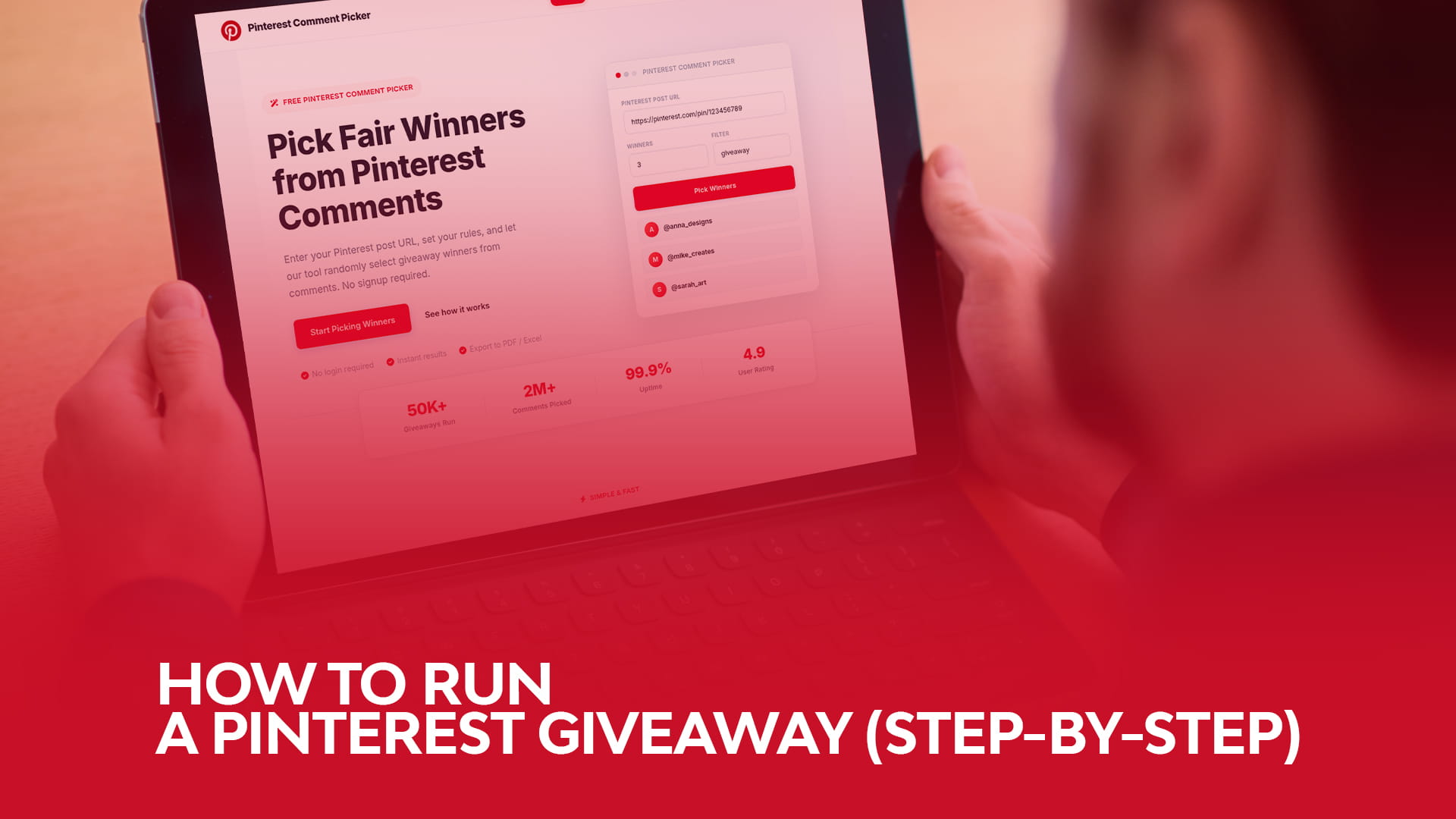
The reliable approach is a dedicated tool that imports every eligible entry, removes duplicates and your own account, gives each entry an equal chance, and produces a result you can prove was random. Paste your Pin URL into the Pinterest Giveaway Winner Picker, apply your filters, and draw the winner in seconds. If you want to understand the mechanics behind a defensible draw — what "random" really means and how to document it — read how to pick a random winner on Pinterest.
The output that matters most here is the timestamped, shareable result. It turns "trust me" into evidence anyone can check, which is what keeps your audience confident enough to enter your next giveaway.
Step 8 — Announce the winner and follow up
Once you've drawn the winner, close the loop quickly and publicly:
- Announce the result on the giveaway Pin and your other channels, and share the proof from your draw so the outcome is transparent.
- Contact the winner by the method you stated in your rules — a comment, a Pinterest message, or email — and give them a clear response deadline.
- Have a backup ready. If the winner doesn't reply in time, re-roll a backup winner; a good picker keeps previous winners excluded automatically so the redraw stays fair.
- Thank everyone who entered. A warm closing message keeps non-winners engaged and primes them for the next contest.
A prompt, transparent announcement is its own form of marketing — it shows future entrants that your giveaways are real and fairly run.
Step 9 — Measure what happened
After the dust settles, look at the numbers against the goal you set in Step 1. Depending on that goal, useful metrics include new followers gained, saves and repins on the Pin, comments and total entries, clicks to your website, and new email subscribers. Compare the cost of the prize and your time against what you gained.
These results tell you what to repeat and what to change. Maybe a product-bundle prize drew far better entrants than a gift card, or a repin-to-enter format spread further than comment-to-enter. Each giveaway becomes data that makes the next one sharper.
Common mistakes that sink Pinterest giveaways
Even a well-intentioned giveaway can underperform for avoidable reasons. Watch for these:
- An off-target prize that attracts prize hunters instead of real prospects.
- Confusing or missing rules that create disputes and erode trust.
- A weak Pin that blends into the feed and never gets discovered.
- No promotion beyond a single Pin, leaving the giveaway to sink quietly.
- A hand-picked or unverifiable winner, which makes people doubt the whole thing.
- Skipping the platform disclaimer or local-law check, which creates unnecessary risk.
Avoiding these is mostly about preparation — and every one of them is addressed in the steps above.
Run your next Pinterest giveaway with confidence
A great Pinterest giveaway is equal parts planning and trust. Set a clear goal, offer a prize your real audience wants, make entry simple, write rules that leave nothing to interpretation, design a Pin built to spread, promote it with intent, and choose a winner fairly and visibly. Handle those well, and you won't just give away a prize — you'll grow an audience that keeps paying off.
When you're ready to draw your winner, PntPicker makes the final step effortless: paste your Pin URL, set your rules, and pick a fair, random, verifiable winner from comments or repins in seconds.
PntPicker is an independent tool. Promotions you run are not sponsored, endorsed, administered by, or associated with Pinterest. This article is general information, not legal advice — always follow Pinterest's guidelines and your local promotion laws.